Standard PackagingPresentaciones Estándar
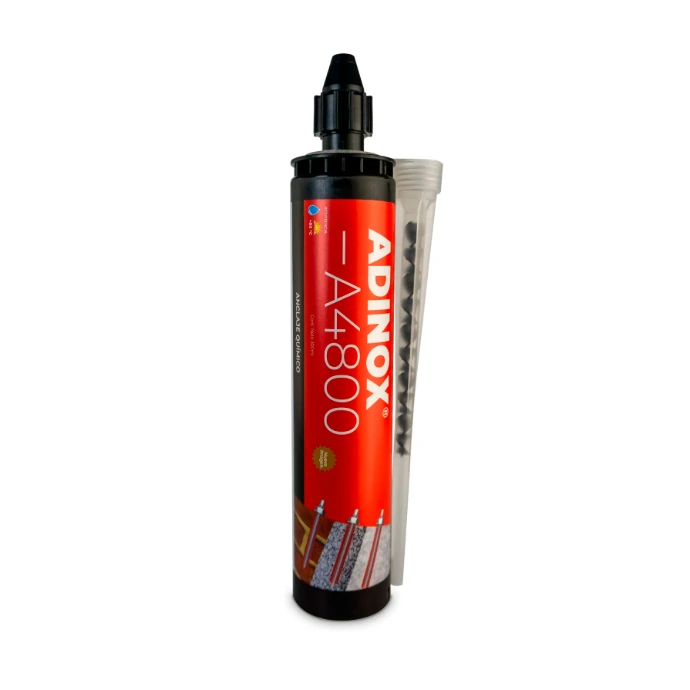
300 ml
Cartridge (10.1 fl oz)
About ADINOX A4800 Chemical Anchor
ADINOX® A4800 is a high-performance chemical anchor — a two-component anchoring mortar dispensed by cartridge through a static mixing nozzle, which cures by chemical reaction to form a high-strength bonded anchor in non-cracked concrete and masonry.
This chemical anchor secures threaded rod from M8 to M24 and connects post-installed rebar (B500, Ø8-Ø16) for static and quasi-static loads, indoors and outdoors. Its high load range and its validity in dry, wet and flooded holes — including overhead installation — make it a versatile solution for fixing machinery, railings, handrails, safety barriers, balconies, canopies, fencing and signage.
High Load Range in Concrete and Masonry
- Anchors threaded rod M8 to M24 in non-cracked concrete from C20/25 to C50/60
- Connects post-installed rebar (B500, Ø8-Ø16) for lap joints and end anchoring in slabs and beams
- Compatible with zinc-plated (class 5.8 / 8.8) and stainless (A2 / A4) threaded rod
- Suitable for solid and hollow brick masonry using the correct screen sleeve
Reliable in Demanding Site Conditions
- Certified for installation in dry, wet and flooded holes
- Valid for overhead (in-ceiling) installation
- Service temperature from -40 °F to +176 °F; max. long-term +122 °F
- For interior and exterior structural applications under static and quasi-static loads
Easy, Foolproof Application
- Dispensed from a 300 ml (10.1 fl oz) or 410 ml (13.9 fl oz) coaxial cartridge with a static mixing nozzle
- A uniform gray mix with no streaks confirms correct mixing before injection
- Injected from the bottom of the hole to avoid air pockets
- 18-month shelf life; usable across a wide temperature window with defined working and curing times
Technical Information
Product Overview
Product type | Two-part injection anchoring mortar, cures by chemical reaction |
Mixed color | Uniform gray (no streaks = correct mix) |
Base material | Non-cracked concrete C20/25 to C50/60; solid and hollow brick masonry |
Anchor elements | Threaded rod M8-M24 (class 5.8 / 8.8, stainless A2 / A4); rebar B500 Ø8-Ø16 |
Load type | Static and quasi-static |
Hole condition | Dry, wet and flooded |
Service temperature | -40 °F to +176 °F; max. long-term +122 °F |
Shelf life | 18 months from date of manufacture |
Installation Parameters in Concrete - Standard Embedment
Thread size | M8 | M10 | M12 | M16 | M20 | M24 |
Drill diameter d0 [in] | 0.39 | 0.47 | 0.55 | 0.71 | 0.87 | 1.02 |
Drill depth h1 [in] | 3.15 | 3.54 | 4.33 | 5.04 | 6.69 | 8.27 |
Max. tightening torque Tinst [ft-lb] | 7.4 | 14.8 | 29.5 | 59.0 | 150 | 147.5 |
Metric anchor sizes (M8-M24) and metric drill bits are used; inch values are approximate conversions. Embedment depth is selectable between 8d (minimum) and 12d (maximum). Table shows the standard embedment; full installation data for all embedment depths, edge and spacing distances is in the Technical Data Sheet.
Characteristic Resistance in Concrete - Standard Embedment
Thread size | M8 | M10 | M12 | M16 | M20 | M24 |
Tension NRk [lbf] | 3,147 | 4,429 | 6,047 | 9,397 | 14,388 | 19,558 |
Shear VRk zinc-plated 5.8 [lbf] | 2,023 | 3,372 | 4,721 | 8,768 | 13,713 | 19,783 |
Shear VRk zinc-plated 8.8 [lbf] | 3,372 | 5,171 | 7,644 | 14,163 | 22,031 | 31,698 |
Shear VRk stainless A2 / A4 [lbf] | 2,923 | 4,496 | 6,744 | 12,364 | 19,334 | 27,876 |
Characteristic values in non-cracked C20/25 concrete, isolated anchor (no edge or spacing effects), standard embedment. 1 kN ≈ 225 lbf ≈ 100 kg. Design values (NRd / VRd) and project-specific verification must be determined by a qualified engineer using the full Technical Data Sheet.
Working and Curing Time
| Cartridge / base material temperature [°F] | Working time [min] | Curing time [min] |
|---|---|---|
| min. +41 | 18 | 145 |
| +41 to +50 | 10 | 145 |
| +50 to +68 | 6 | 85 |
| +68 to +77 | 5 | 50 |
| +77 to +86 | 4 | 40 |
| +86 | 4 | 35 |
Minimum cartridge temperature +5 °C; base material temperature ≥ +5 °C. Apply the tightening torque only after the full curing time.
Masonry & Post-Installed Rebar
Masonry: validated in solid clay brick and hollow brick. In hollow brick, install the appropriate plastic screen sleeve and fill it completely. Drill in rotation only (not hammer/percussion). Installation parameters and resistances by brick type are detailed in the Technical Data Sheet.
Post-installed rebar: connects corrugated rebar B500 (Ø8-Ø16, 0.31-0.63 in) in non-carbonated concrete C12/15 to C50/60 for lap splices in slabs and beams, end anchoring, and compression connections under static / quasi-static loads. Bond design values by concrete class are in the Technical Data Sheet.
Storage & Shelf Life
| Storage temperature | +41 °F to +77 °F |
| Shelf life (unopened, from manufacture) | 18 months |
| Storage conditions | Dry and cool, protected from direct sunlight and heat sources |
| Expiry | Printed on the cartridge |
How to Use ADINOX A4800?
Drill and Clean the Hole
- Drill to the specified diameter and depth — hammer drilling in concrete, rotation only in masonry
- Blow and brush the hole to remove dust, debris and water — repeat until clean (dry, wet or flooded holes are all acceptable)
- Cartridge and base material must be at least +41 °F
Prepare the Cartridge
- Screw on the static mixing nozzle and load the cartridge into the dispensing gun
- Purge the first strokes until the mortar is a uniform gray with no streaks
- In hollow masonry, place the screen sleeve in the hole before injecting
Inject, Set and Cure
- Inject from the bottom of the hole, slowly withdrawing the nozzle to avoid air pockets — fill about ½ to ¾
- Insert the threaded rod or rebar with a slight turning motion until it reaches the bottom, within the working time — mortar should overflow slightly
- Do not disturb the anchor during the curing time; apply the tightening torque only after full cure, without exceeding the maximum value
Get the ADINOX A4800 chemical anchor through our authorized distributor network, in 300 ml coaxial cartridges (boxes of 12).
Join our distributor network and offer your customers a high-performance chemical anchor for concrete, masonry and rebar fixing programs.
Become a Partner
Where to Buy?
If you are using ADINOX A4800, you may be interested in
Si usa ADINOX C1500, también le puede interesar
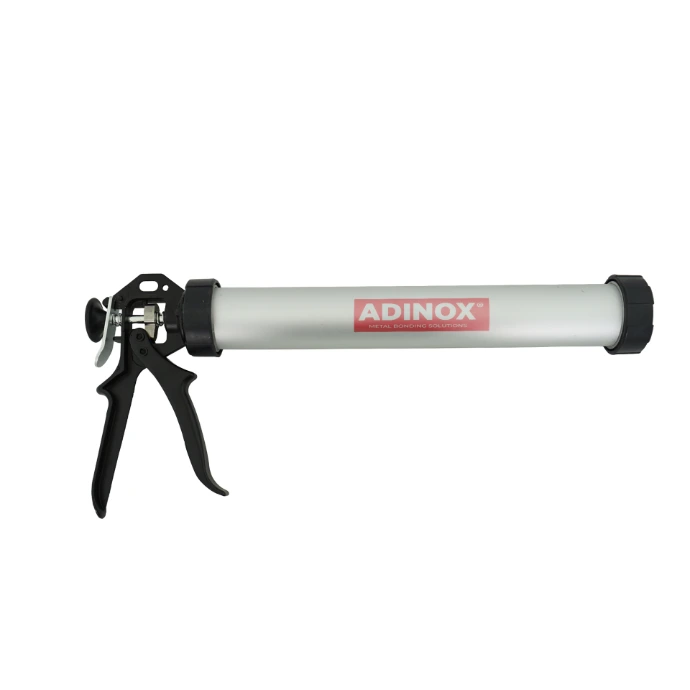
Dispensing Guns
For 300 ml Cartridges
Manual and pneumatic guns for coaxial cartridges. Required to dispense A4800.
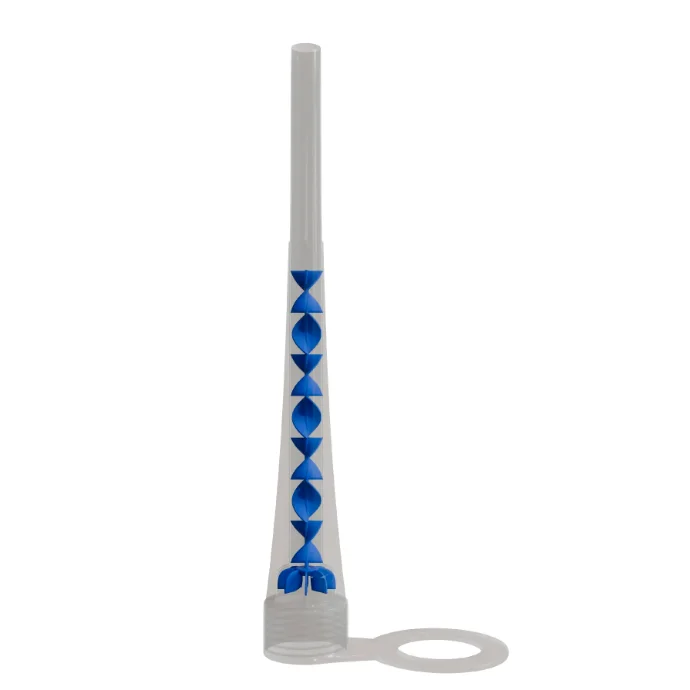
Static Mixing Nozzles
For Coaxial Cartridges
Ensure a homogeneous mix of both components. Essential companion for A4800.
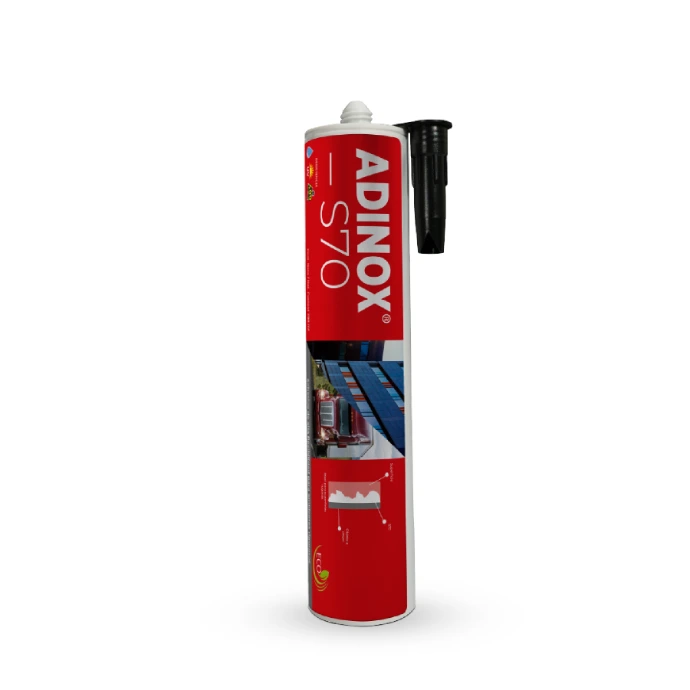
ADINOX® S70
Instant-Tack Sealant-Adhesive
Flexible MS Polymer sealant-adhesive with instant tack. Isocyanate-free and zero VOC.
Frequently Asked Questions
What is the ADINOX A4800 chemical anchor?
ADINOX A4800 is a two-part injection anchoring mortar dispensed by cartridge through a static mixing nozzle. It cures by chemical reaction to form a high-strength bonded anchor for threaded rod and rebar in non-cracked concrete and masonry.
Which base materials and anchors does A4800 support?
It works in non-cracked concrete from C20/25 to C50/60 and in solid and hollow brick masonry. It anchors threaded rod M8-M24 (zinc-plated class 5.8 / 8.8 and stainless A2 / A4) and post-installed rebar B500 in sizes Ø8-Ø16.
Can A4800 be installed in wet or flooded holes?
Yes. A4800 is validated for dry, wet and flooded (water-filled) holes, and for overhead installation. Always blow and brush the hole clean before injecting.
How do I know the mortar is mixed correctly?
Discard the first strokes from the nozzle until the mortar comes out a uniform gray with no streaks. That uniform gray color is the indicator of a correct mix.
What are the working and curing times?
They depend on temperature. At +68 to +77 °F the working time is about 5 minutes and the curing time about 50 minutes; at +41 °F the working time extends to 18 minutes and curing to 145 minutes. Cartridge and base material must be at least +41 °F.
What is the service temperature range?
Once cured, A4800 performs from -40 °F to +176 °F, with a maximum long-term service temperature of +122 °F .
Is A4800 suitable for cracked concrete or seismic loads?
No. A4800 is qualified for non-cracked concrete and for static and quasi-static loads only. It is not qualified for cracked concrete or for dynamic, fatigue or seismic loads.
What sizes and shelf life does A4800 have?
A4800 is supplied in 300 ml (10.1 fl oz) and 410 ml (13.9 fl oz) coaxial cartridges, in boxes of 12. Unopened, it has an 18-month shelf life from the date of manufacture when stored dry and cool between +41 °F and +77 °F, away from direct sunlight and heat.